Generator vs Solar in Ethiopia: 2026 Cost & Reliability Comparison
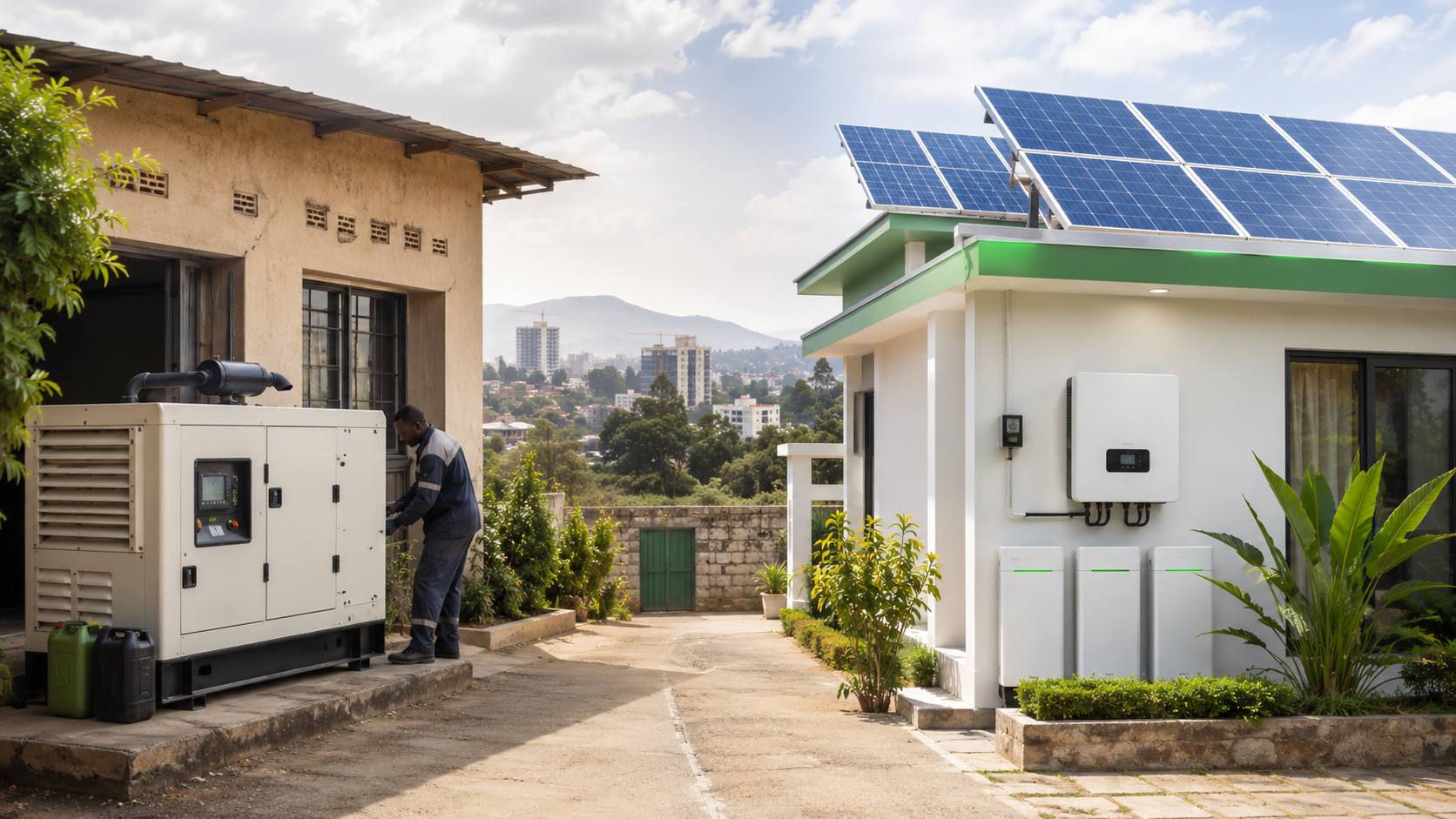
For many homes and businesses in Ethiopia, a diesel generator has traditionally been the first solution when grid electricity becomes unreliable.
It is easy to understand why. A generator can provide substantial power quickly, the technology is familiar, and the initial investment is often lower than installing a complete solar and battery system.
But the economics of backup power are changing.
Diesel prices have increased significantly, electricity tariffs are undergoing gradual reform, and modern solar-battery systems can now manage solar generation, battery storage, grid electricity and—in selected configurations—even an existing generator.
This raises an increasingly important question:
Is it more economical to continue relying on a generator, or does investing in solar and battery storage make better long-term sense?
The answer cannot be found by comparing purchase prices alone.
A professional comparison must consider the total cost of ownership, including fuel, maintenance, system lifetime, battery capacity, outage duration, electricity consumption and the financial impact of downtime.
This guide explains the key differences.
Key Takeaway
- Diesel generators generally have a lower initial purchase cost but create continuous fuel and maintenance expenses.
- Solar and battery systems usually require a higher upfront investment but have much lower variable operating costs.
- Frequent generator use can make diesel one of the largest long-term backup-power expenses.
- Modern hybrid systems can automatically coordinate solar, battery and grid electricity.
- Selected systems can also integrate a generator for extended backup.
- LiFePO₄ batteries can provide thousands of charge/discharge cycles, although performance varies by product and operating conditions.
- Correct system sizing is more important than simply selecting the largest inverter or battery.
- Solar payback should be calculated for the individual project rather than promised as a universal three-, four- or five-year return.
1. Why Backup Power Matters in Ethiopia
Ethiopia has substantial renewable-energy resources and generates much of its electricity from hydropower. However, electricity users can still experience local outages, distribution constraints, scheduled interruptions and voltage fluctuations. For a household, an outage can interrupt lighting, internet access, refrigeration, water pumping, communications, home-office equipment and security systems. For a business, the financial consequences can be much larger. Power interruptions can affect manufacturing, retail operations, refrigeration, IT infrastructure, pumps and motors, communications, medical equipment, security and customer service. For these users, reliable electricity is not simply about convenience. It is part of business continuity. At the same time, Ethiopia is implementing a multi-year electricity tariff reform program, making energy-cost planning increasingly important. That makes it worthwhile to ask: How much does every hour of backup electricity actually cost?
2. Generator vs Solar: Two Different Energy Models
Diesel Generator
A diesel generator converts fuel into mechanical energy and then into electricity.
Its main advantage is simple: as long as sufficient fuel is available, it can continue producing electricity.
This makes generators useful for very long outages, large temporary loads, remote operations and critical facilities.
However, every hour of operation consumes fuel, adds engine operating hours, produces noise and exhaust emissions, and moves the generator closer to its next maintenance interval.
So although the purchase price may be relatively low, a generator creates a continuous operating cost.
Solar + Battery Backup
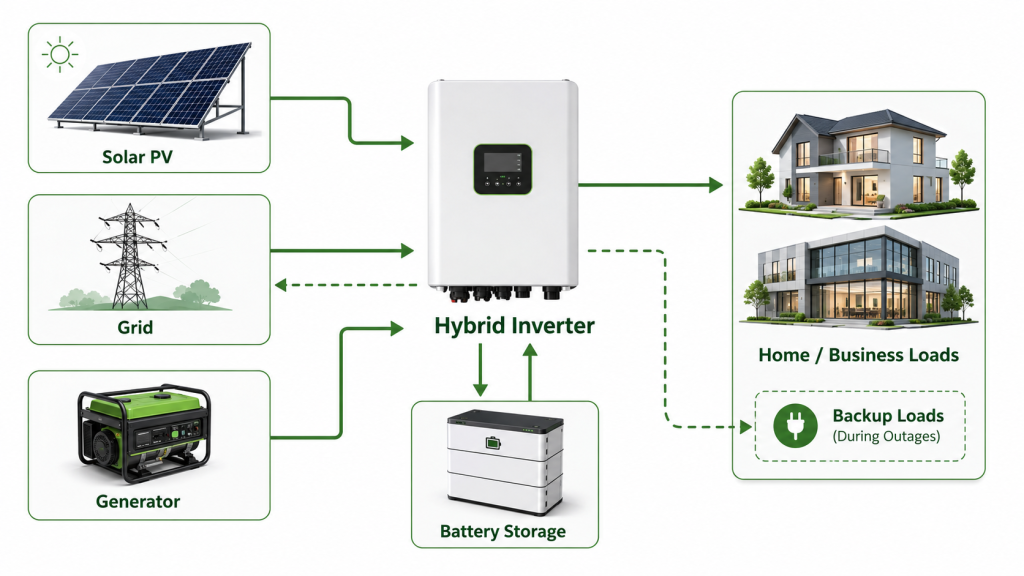
A solar-battery system works differently. Solar PV modules generate electricity during daylight hours, while a battery stores energy so it can be used later, including during grid outages. A modern hybrid inverter can automatically coordinate several energy sources, for example:
Solar → Loads → Battery → Grid
When enough solar energy is available, the building can use it directly. Excess solar production can charge the battery, and stored energy can then support selected loads when grid electricity is unavailable.
For more critical applications, the system can also be designed around:
Solar + Battery + Grid + Generator
This means the customer does not always have to choose between solar and a generator. A properly engineered system can use both, while reducing how often the generator needs to run.
3. The Real Cost of Diesel Generator Operation
The purchase price of a generator is only one part of its lifetime cost.
The largest recurring expense is usually fuel.
Published fuel-price data for 24 August 2026 estimated Ethiopian diesel at approximately 180.46 ETB per litre, or about USD 1.12 per litre.
Fuel prices change, so any serious project calculation should always use the current local diesel price at the time of assessment.
Consider a simple example:
If a generator consumes 3 litres per hour and operates 4 hours per day, it uses:
12 litres per day
If it runs for 300 days per year, annual diesel consumption would be:
3,600 litres
At 180.46 ETB per litre, that corresponds to roughly:
650,000 ETB per year in fuel alone
This is only an example. Actual fuel consumption depends on generator size, load level, engine efficiency, maintenance condition and operating environment.
But it shows why a generator that is cheap to buy can become expensive when it runs frequently.
4. Maintenance Adds Another Generator Cost
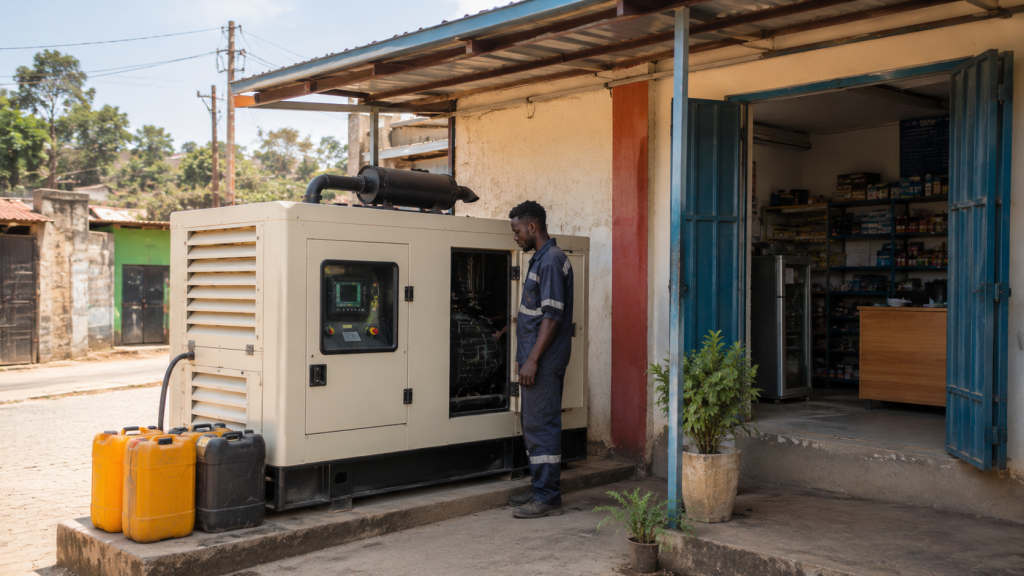
A diesel generator is a mechanical system, and regular servicing is part of its operating cost.
Depending on the manufacturer, generator size and operating conditions, maintenance may include:
• engine-oil replacement
• oil-filter replacement
• fuel-filter replacement
• air-filter inspection or replacement
• cooling-system inspection
• starter-battery maintenance
• belt inspection
• fuel-system servicing
• electrical testing
A generator used only occasionally for emergency backup has a very different cost profile from one operating several hours every day.
Frequent operation means:
more fuel + more maintenance + more mechanical wear
Solar PV systems have a different maintenance profile. They do not require fuel or engine servicing, but they are not completely maintenance-free.
A professional solar installation should still receive periodic inspection of:
• PV modules
• mounting structures
• electrical connections
• DC and AC protection
• inverter operation
• battery condition
• monitoring
• earthing and protective equipment
Dust accumulation is also important in many Ethiopian environments because heavy dust on the modules can reduce solar production.
5. Solar Requires More Investment Upfront
A complete solar-battery system usually requires a higher initial investment than a basic generator.
A professional installation may include:
• solar PV modules
• hybrid inverter
• battery storage
• mounting structure
• DC protection
• AC protection
• cabling
• monitoring
• engineering
• installation
• testing and commissioning
Battery storage can represent a significant part of the total system cost.
This is why it is misleading to compare only the purchase price of a generator with the purchase price of a solar system.
A better comparison is:
Generator Total Cost of Ownership
Purchase + Fuel + Maintenance + Repairs + Future Replacement
versus
Solar Total Cost of Ownership
Purchase + Installation + Maintenance + Future Component Replacement − Avoided Energy Costs
This is the Total Cost of Ownership, or TCO
6. A Simple Solar Savings Example
Imagine a business currently spends 50,000 ETB per month on diesel for backup generation.
That equals:
600,000 ETB per year
If a properly designed solar-battery system could reduce generator use by 80%, the theoretical avoided fuel expenditure could approach:
480,000 ETB per year
But this should not immediately be treated as actual profit or guaranteed savings.
A proper financial analysis should also consider:
• solar-system purchase cost
• expected solar production
• battery efficiency
• remaining generator use
• grid electricity consumption
• maintenance
• financing
• battery replacement assumptions
• future fuel prices
• future electricity tariffs
This is why responsible solar engineering should avoid blanket claims such as:
“Solar always pays for itself in three years.”
For a business running a generator every day, solar may provide strong savings. For a household experiencing only occasional short outages, the payback period may be much longer.
7. Battery Technology: Why LiFePO₄ Matters
The battery is one of the most important components of a modern backup system.
Older backup installations often use lead-acid batteries, while modern energy-storage systems increasingly use:
Lithium Iron Phosphate — LiFePO₄ / LFP
Depending on the manufacturer, operating temperature, depth of discharge and other conditions, modern LFP batteries can provide thousands of charge/discharge cycles.
However, not every lithium battery is the same.
Important specifications include:
• nominal capacity
• usable capacity
• depth of discharge
• maximum charge power
• maximum discharge power
• cycle-life specification
• Battery Management System (BMS)
• operating temperature
• inverter compatibility
• certifications
• manufacturer warranty
• technical support
The cheapest battery per kWh is therefore not automatically the battery with the lowest lifetime cost.
A professional system should consider performance, compatibility, warranty and serviceability together.
8. Can Solar Run Air Conditioning, Pumps and Machinery?
Yes — but only if the system is correctly engineered for the load.
One of the most common mistakes is to look only at battery capacity.
For example:
A 10 kWh battery does not automatically mean the system can provide 10 kW of power.
Power and energy are different.
Professional system sizing must consider:
Peak Power — kW
The maximum power the system must supply at one time.
Energy Consumption — kWh
The total amount of electricity required over a period of time.
Equipment such as:
• air conditioners
• water pumps
• compressors
• refrigeration systems
• workshop machinery
• medical equipment
may also have significant starting currents.
The inverter, battery and electrical installation therefore need to be selected as one coordinated system.
9. Residential Solar Backup in Ethiopia
Many Ethiopian homes do not need to back up every electrical appliance during an outage.
A more economical approach is often to identify essential loads first.
These may include:
• lighting
• Wi-Fi/router
• refrigerator
• television
• phone charging
• laptop charging
• security equipment
• selected sockets
Larger systems can additionally support:
• water pumps
• air conditioning
• washing machines
• electric cooking
• other high-power appliances
The correct backup solution therefore starts with two questions:
What must continue operating during an outage?
and
For how many hours?
This is why a professional load assessment should come before choosing the inverter or battery.
10. Solar Backup for Ethiopian Businesses
Businesses often have an even stronger reason to consider solar and battery storage because the cost of a power interruption can be much greater than the value of the electricity itself.
An outage can affect:
• production
• sales
• refrigerated goods
• computers and servers
• communication systems
• pumps and motors
• security systems
• medical equipment
• customer service
For these users, energy storage becomes part of a business-continuity strategy.
A commercial system may use:
Grid + Solar + Battery
or, for more critical operations:
Grid + Solar + Battery + Generator
For businesses that already own a generator, the second configuration can be particularly useful.
Instead of replacing a functioning generator, solar and battery storage can reduce how often it needs to run. The generator then becomes an emergency source for unusually long outages rather than the first response to every interruption.
11. SOFAR Hybrid Systems as One Option for Ethiopia
One technology platform Yagi GreenVision is evaluating for suitable residential and commercial projects in Ethiopia is SOFAR.
SOFAR offers hybrid inverter and battery-storage solutions that can combine solar PV generation, battery storage, utility-grid supply, backup power during outages and energy-management functions.
For selected compatible systems, generator integration can also be considered. This is especially relevant in Ethiopia because customers do not necessarily need to abandon an existing generator.
A suitable hybrid architecture may therefore combine:
Solar + Battery + Grid + Generator
During normal operation, solar can supply the loads and charge the battery. During a grid outage, the battery can support selected backup loads. If an outage continues for a longer period, a compatible generator can provide an additional energy source.
This approach can help reduce:
• diesel consumption
• generator operating hours
• mechanical maintenance
• noise
• fuel-storage requirements
For many Ethiopian homes, single-phase hybrid systems are especially relevant, while larger businesses may require three-phase solutions.
However, Yagi GreenVision does not recommend a system simply because of the brand name. Before selecting any SOFAR configuration, the exact inverter and battery system should be evaluated for:
• required backup power
• daily energy consumption
• battery capacity
• PV capacity
• installation altitude
• ambient temperature
• single-phase or three-phase supply
• generator compatibility
• monitoring
• warranty and technical support
The goal is not to use SOFAR for every project.
The goal is to determine whether the selected SOFAR solution provides the right balance of reliability, performance, expandability and cost for the customer.
12. Why Generator Integration Can Be Valuable
For some Ethiopian businesses and critical facilities, the most practical solution may not be:
Generator OR Solar
but:
Grid + Solar + Battery + Generator
During normal operation, solar can supply part of the load and charge the battery.
When solar production is insufficient, the grid can supplement the system.
During a grid outage, the battery can supply selected backup loads.
If the outage continues and the available battery energy becomes insufficient, a compatible generator can provide an additional source of energy.
This approach can reduce:
• diesel consumption
• generator operating hours
• mechanical maintenance
• noise
• local exhaust emissions
• fuel-storage requirements
while still keeping an additional layer of backup available.
For critical facilities, this can be more practical than designing either solar or diesel as the only energy source.
13. Should Every Ethiopian Customer Use SOFAR?
No.
SOFAR is one possible technology platform, but it should not be treated as the right solution for every project.
Before recommending a specific SOFAR inverter or battery system, Yagi GreenVision should evaluate:
• installation altitude
• ambient temperature
• single-phase or three-phase supply
• grid characteristics
• required backup power
• daily energy consumption
• required battery capacity
• available PV capacity
• generator compatibility where required
• communication and monitoring
• manufacturer warranty
• local technical-support arrangements
The same principle applies to every manufacturer.
A good solar project should not start with:
“Which brand do we want to sell?”
It should start with:
“What does this customer actually need?”
The objective is to select equipment that provides the right balance of reliability, compatibility, performance, serviceability and cost.
14. Do You Still Need a Generator After Installing Solar?
Not necessarily.
For many homes and small businesses, a correctly sized solar-battery system can handle normal grid interruptions without starting a generator.
Critical facilities are different.
Examples include:
• hospitals and clinics
• hotels
• manufacturing facilities
• data and communication infrastructure
• large commercial buildings
• remote operations
For these applications, additional redundancy can be valuable.
Keeping an existing generator may provide protection against unusually long outages, poor solar conditions or exceptional loads.
The generator then becomes a secondary or tertiary emergency source rather than the primary response to every outage.
15. Reliability Depends on Engineering, Not Just Brand
A premium inverter does not automatically create a premium solar installation.
A high-quality inverter connected to an incorrectly sized battery can still result in poor system performance.
Likewise, an expensive battery installed without appropriate electrical protection does not create a safe or reliable system.
Long-term reliability depends on the complete engineering process.
At Yagi GreenVision, this means focusing on:
Load Assessment
Understanding how much power and energy the customer actually requires.
System Sizing
Selecting appropriate PV, inverter and battery capacities.
Component Compatibility
Ensuring the inverter, battery, monitoring and control systems are designed to operate together.
Electrical Protection
Correctly designing cable sizes, isolation, AC protection, DC protection and earthing.
Environmental Conditions
Considering temperature, dust, altitude and the installation environment.
Monitoring
Providing visibility into solar production, battery status and overall system performance.
Expandability
Where technically appropriate, allowing the system to grow as the customer’s requirements increase.
16. Yagi GreenVision: Local Ethiopian Support with German Engineering Experience
Yagi GreenVision combines local understanding of Ethiopian energy needs with engineering experience developed in Germany.
Our technical approach is guided by professional engineering principles, with emphasis on correct system sizing, electrical safety, component compatibility, long-term reliability and maintainability.
The engineering background behind Yagi GreenVision includes professional experience in photovoltaic system planning and design in Germany. The engineering qualification of our technical management has also been formally recognized by Ingenieurkammer Hessen in Germany, supporting the use of the professional title Ingenieur under the applicable German engineering regulations.
Through technical experience and cooperation with SoPlus GmbH in Darmstadt, Germany, Yagi GreenVision aims to transfer proven engineering practices to solar and energy-storage projects in Ethiopia.
Our priorities include:
• professional load assessment
• correct PV, inverter and battery sizing
• electrical safety and protection
• reliable and compatible components
• manufacturer-supported warranties
• monitoring and maintainability
• expandable system architecture
• long-term system performance
For Yagi GreenVision, German engineering standards do not simply mean using German-made products. They mean applying disciplined design, documented technical decisions, proper protection and professional installation practices regardless of where the selected equipment is manufactured.
The goal is simple:
Deliver energy systems that are technically sound, safe, reliable and appropriate for Ethiopian conditions.
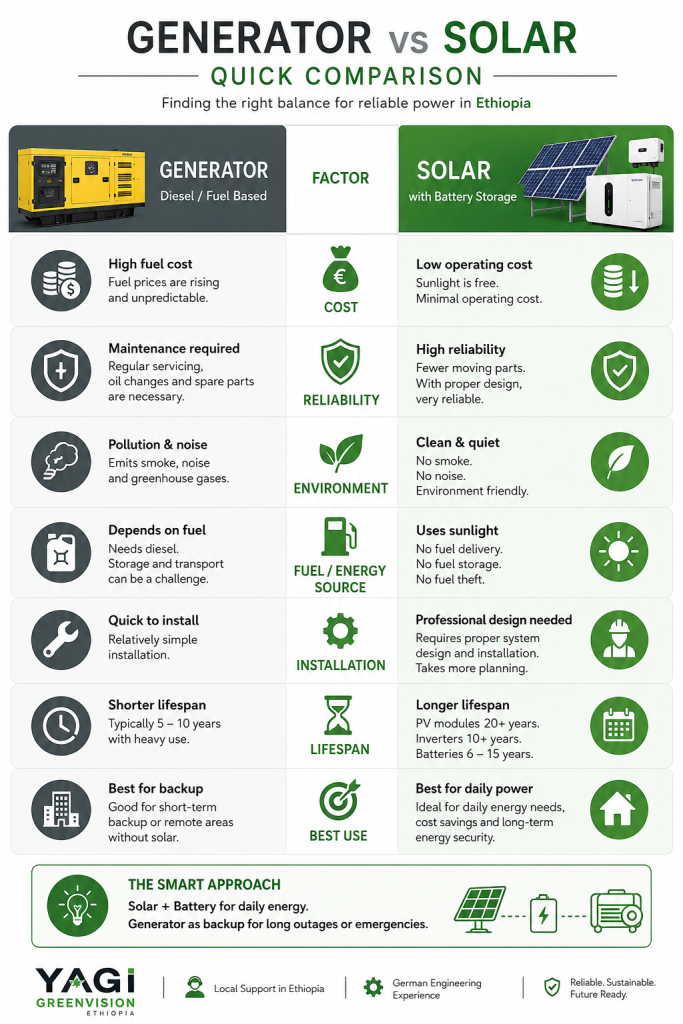
17. Generator vs Solar: Quick Comparison
18. Which Solution Is Right for You?
A Generator May Still Make Sense When:
• grid outages are rare
• backup is required only occasionally
• very high power is needed for short periods
• initial investment must be minimized
• suitable solar installation area is unavailable
• extremely long backup duration is required
Solar + Battery Becomes Particularly Attractive When:
• outages are frequent
• generator fuel consumption is already high
• electricity is required every day
• quiet operation is important
• automatic backup is required
• long-term operating-cost stability matters
• solar can also reduce normal daytime grid consumption
Solar + Battery + Generator May Be Best When:
• the facility is mission-critical
• outages can last many hours or days
• the customer already owns a generator
• maximum redundancy is required
• the objective is to reduce, rather than completely eliminate, generator operation
19. The Most Important Comparison: Total Cost of Ownership
Choosing between a diesel generator and a solar-battery system should not be based on the equipment price alone.
A generator may be relatively inexpensive to purchase but expensive to operate.
A solar system may require a higher upfront investment but comparatively low variable operating costs.
The right decision starts with four questions:
1. What is your maximum load in kW?
2. How many kWh do you consume each day?
3. How long do your typical grid outages last?
4. How much do you currently spend on generator fuel and maintenance?
From these numbers, a professional assessment can estimate:
• required inverter capacity
• required solar PV capacity
• required battery storage
• expected solar generation
• potential generator-runtime reduction
• estimated fuel savings
• backup duration
• approximate long-term return
This gives the customer a much stronger basis for an investment decision than simply choosing equipment from a catalogue.
Conclusion: From Emergency Backup to Intelligent Energy Management
Diesel generators will continue to play an important role in Ethiopia, especially where very long backup duration or critical emergency redundancy is required.
But using a generator as the first response to every grid interruption can become expensive.
Modern solar and battery systems offer a different approach. They can produce electricity during daylight hours, store energy for later use, automatically support essential loads and reduce generator operating hours.
In suitable projects, solar, battery storage, grid electricity and a generator do not need to compete with each other. They can work together as one coordinated energy system.
The best solution is therefore not automatically:
the largest battery,
the cheapest inverter,
or
the most expensive brand.
The best solution is a system that is correctly engineered for the customer’s actual electrical requirements, operating conditions and budget.
Request a Professional Solar Assessment
If your home or business currently depends on a generator during power interruptions, Yagi GreenVision can assess whether solar and battery storage could reduce fuel consumption, improve reliability and provide a better long-term energy solution.
A professional assessment can consider:
• current electricity consumption
• generator size and fuel usage
• essential backup loads
• required backup duration
• available roof or ground area for solar
• battery requirements
• inverter capacity
• future expansion
• generator integration where appropriate
Request a Professional Solar Assessment from Yagi GreenVision.
Frequently Asked Questions
Is solar cheaper than a generator in Ethiopia?
Solar can be cheaper over the long term, especially when a generator is used frequently.
A generator usually has a lower upfront cost, but it creates ongoing expenses for fuel, servicing and mechanical wear.
A solar-battery system normally costs more to install initially, but its variable operating costs are much lower.
The correct comparison should therefore be based on total cost of ownership, not only the purchase price.
What is the diesel price in Ethiopia in 2026?
As of 24 August 2026, published fuel-price data lists diesel in Ethiopia at approximately 180.46 ETB per litre, or about USD 1.12 per litre.
Fuel prices can change, so this figure should be treated as a dated reference rather than a permanent price.
For any customer proposal or return-on-investment calculation, Yagi GreenVision should use the current local diesel price at the time of assessment.
How long does a solar battery last?
There is no single lifespan that applies to every battery.
Modern LiFePO₄ batteries can often provide thousands of charge and discharge cycles, but actual service life depends on factors such as:
• battery model and manufacturer
• operating temperature
• depth of discharge
• charge and discharge rates
• daily usage pattern
• battery management system
• installation quality
Some manufacturers also provide warranties of around 10 years, depending on the specific product.
The important point is to evaluate the actual battery warranty and cycle-life specification, rather than assuming all lithium batteries perform the same.
Can solar backup operate air conditioning?
Yes — if the system is properly sized.
The inverter must be able to supply the air conditioner’s running power and starting demand, while the battery must provide enough stored energy for the required operating time.
The most important factors are:
• air-conditioner power rating
• starting current
• number of units running at the same time
• desired backup duration
• inverter output capacity
• battery capacity and discharge capability
A professional load assessment should therefore be completed before selecting the inverter and battery.
Can solar operate pumps or industrial machinery?
Yes — when the system is properly engineered.
Pumps, compressors, motors and industrial machinery can have high starting currents and may require significantly more power during startup than during normal operation.
A professional design should therefore consider:
• continuous operating power
• starting or surge current
• number of machines operating simultaneously
• required backup duration
• inverter output capacity
• battery discharge capability
• three-phase requirements where applicable
For larger commercial or industrial loads, detailed load analysis is essential before selecting the inverter, battery and protection system.
Can a SOFAR system work with a generator?
Yes — selected SOFAR hybrid inverter systems can support generator integration, depending on the specific inverter model and system configuration.
In a compatible setup, the generator can remain as an additional backup source when grid power is unavailable and solar or battery energy is insufficient.
For Ethiopian installations, this can be particularly useful because an existing generator does not necessarily need to be removed. Instead, the solar-battery system can handle most normal outages while the generator is reserved for longer interruptions or unusually high energy demand.
Before installation, the exact system should be checked for:
• generator compatibility
• required control and communication interface
• generator power rating
• battery charging limits
• single-phase or three-phase configuration
• inverter and battery compatibility
• manufacturer installation requirements
The correct approach is therefore:
Use the generator as an additional backup source, while solar and battery storage reduce how often it needs to run.
Do I need to remove my existing generator after installing solar?
No.
If the generator is still in good condition, it can remain as an additional backup source.
A solar-battery system can handle normal daily energy use and many grid outages, while the generator remains available for unusually long interruptions or critical situations.
This can help reduce:
• generator operating hours
• diesel consumption
• mechanical wear
• maintenance frequency
• noise
while preserving another layer of energy security.
For many businesses, the better strategy is not to remove the generator immediately, but to reduce how often it needs to run.
Does a solar system require maintenance?
Yes.
Solar systems generally require less maintenance than diesel generators, but they are not maintenance-free.
A professional maintenance plan may include:
• cleaning PV modules when dust or dirt reduces performance
• checking mounting structures
• inspecting DC and AC connections
• checking protective devices
• monitoring inverter operation
• reviewing battery status
• checking earthing and grounding
• reviewing system alarms and monitoring data
In dusty environments, module cleaning can be especially important.
The goal is not frequent mechanical servicing, but periodic inspection to keep the system safe, efficient and reliable.
How much battery capacity does my home need?
There is no single battery size that is right for every home.
The required capacity depends mainly on:
• which appliances must remain powered during an outage
• how much energy those appliances use
• how many hours of backup are required
• the inverter size
• available solar generation
• budget and future expansion plans
For example, a home backing up only lighting, Wi-Fi, a refrigerator and a few sockets may need much less storage than a home that also wants to run air conditioning, pumps or electric cooking.
The correct approach is to calculate the essential loads first and then size the battery around the required backup time.
How can I compare solar with my existing generator?
Start by collecting a few real operating figures from your current generator:
• generator size in kVA or kW
• diesel consumption per hour
• typical operating hours per day
• monthly fuel expenditure
• maintenance costs
• typical outage duration
• important loads that must remain powered
Yagi GreenVision can then compare those figures with a properly sized solar-battery solution and estimate:
• required PV capacity
• inverter size
• battery capacity
• expected backup duration
• potential generator-runtime reduction
• possible fuel savings
• approximate long-term operating cost
The most useful comparison is based on your actual consumption and generator usage, not on generic package sizes.